Dental 3D printing has become a practical part of digital dentistry. For dental laboratories, clinics, and technology buyers, resin selection is as important as printer selection because it affects accuracy, strength, fit, workflow, and application. Understanding dental 3D printing resin therefore requires more than comparing price or curing wavelength. Buyers need to match material properties with the task.
What Is Dental 3D Printing Resin?
Dental 3D printing resin is a light-curable polymer material used in vat photopolymerization processes. During printing, controlled light exposure selectively cures liquid resin layer by layer to create a digital design. SLA, DLP, and LCD are among the principal vat-photopolymerization technologies used in dentistry.
The resin formulation determines how a printed component behaves after curing. Strength, dimensional stability, surface characteristics, biocompatibility, and wear resistance can influence suitability. Consequently, dental resins should be evaluated according to their stated indication rather than treated as interchangeable consumables.
Why Resin Selection Matters in Dental Production
A dental laboratory may use different resins for models, surgical guides, splints, trays, try-in dentures, denture bases, or temporary restorations. Each workflow can impose different requirements. A material designed for a diagnostic model should not automatically be considered appropriate for a device with prolonged clinical contact.
For business buyers, this distinction also affects production planning. Resin compatibility, required wavelength, post-processing, dimensional requirements, and certification can influence equipment utilization and quality control. A suitable material can support a more predictable workflow, while an unsuitable resin can create rework and fitting problems.
Key Properties to Evaluate Before Buying
Strength and dimensional stability are practical starting points. Printed dental components must retain their intended geometry after curing and handling. For functional try-in procedures, stability and fit are particularly important because inaccuracies can complicate clinical assessment and adjustment.
Biocompatibility is another critical consideration for dental applications. Evidence and regulatory status depend on the intended use and market. Buyers should review the manufacturer’s documentation and use each resin only within its specified indication. Published research emphasizes that post-rinsing and post-curing can be important for intended material performance and biocompatibility.
Wear resistance and chemical behavior can matter when a printed component is repeatedly handled or exposed to oral conditions. Surface finish and cleanability may also affect laboratory efficiency. Procurement teams should therefore assess complete technical data rather than one headline specification.
Understanding LCD and DLP Compatibility
LCD and DLP systems both belong to vat photopolymerization, but their light-delivery approaches differ. LCD systems use a screen to control which areas of the resin are exposed, while DLP systems project patterned light. A resin’s specified wavelength compatibility is therefore an essential purchasing parameter.
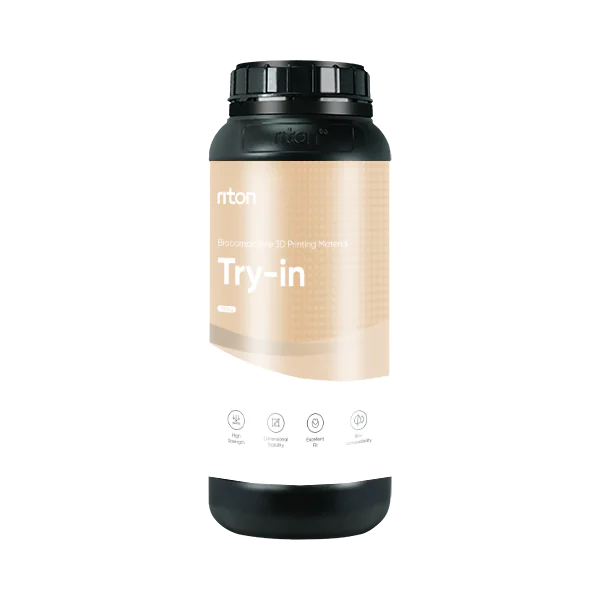
Riton’s TN 1.0 illustrates why application and equipment compatibility matter together. The material is a specialized dental photopolymer resin for producing full try-in dentures and is designed for removable prosthodontics. Its stated applicable equipment is LCD/DLP, with an applicable wavelength range of 385–405 nm.
Riton TN 1.0: A Try-In Denture Resin Example
For dental laboratories evaluating full try-in dentures, Riton’s TN 1.0 is positioned around practical clinical verification. It enables checking occlusion records and denture fit during try-in, helping simplify occlusal adjustment. The material is intended for normal occlusion conditions and is described as offering extremely low wear, corrosion resistance, and easy cleaning.
Its listed product features include high strength, dimensional stability, biocompatibility, and excellent fit. Packaging specification: 1 kg per bottle. Riton lists this specific material with FDA and CE certifications, and its stated application is removable prosthodontics. These details should be checked against current product documentation before procurement and use. Riton also lists TN1.0 within its try-in resin portfolio.
What to Look for in a Dental Resin Manufacturer
Choosing a dental resin manufacturer is not only a material decision. Business customers should consider whether the supplier can provide consistent technical documentation, application-specific materials, compatible printing systems, and appropriate certification information. Supply stability and technical support also matter when a laboratory moves to repeatable manufacturing.
Riton provides dental 3D printing solutions covering resin materials and resin 3D printers. Its official product portfolio organizes resin materials by applications including dental models, surgical guides, gingiva masks, try-in, denture bases, trays, splints, crowns, and denture teeth. This portfolio helps buyers evaluate materials according to workflow needs rather than treating resin as a generic consumable.
Building a More Reliable Resin Selection Process
A practical purchasing process can begin with the dental application. Next, the buyer can verify printer technology, wavelength, material indication, mechanical requirements, and certification. The laboratory should then review the manufacturer’s recommended printing and post-processing procedures before routine production.
It is also useful to evaluate repeatability rather than a single successful print. Production teams can monitor fit, dimensional consistency, surface quality, failure rates, and post-processing across multiple batches. This creates a basis for comparing suppliers and controlling costs.
Making Resin a Strategic Part of Digital Dentistry
Dental 3D printing resin is a core component of digital dental production, not simply a consumable purchased after the printer has been selected. The right resin must match the application, printer, wavelength, performance, and regulatory expectations. For business decision-makers, this approach can reduce production issues and support consistent workflows.
Riton‘s TN 1.0 demonstrates the value of application-specific development: it is designed for full-arch try-in dentures, supports LCD/DLP systems at 385–405 nm, comes in 1 kg bottles, and is FDA- and CE-certified. As digital dentistry continues to expand, evaluating materials through documented specifications and intended applications will remain essential for laboratories and clinics seeking reliable production.