Industrial gas detection plays an essential role in protecting workers, maintaining operational safety, and preventing hazardous incidents in confined and potentially contaminated environments. Among the available options, Industrial Scientific, RKI Instruments, and Bosean offer gas detection solutions for different industrial requirements.
Choosing the right equipment involves evaluating sensor performance, gas monitoring capabilities, durability, usability, and maintenance needs. This article examines four gas detector options and explains what industrial buyers should consider when selecting equipment for workplace safety.
Why Gas Detection Matters in Confined Spaces
Confined spaces such as storage tanks, pipelines, underground facilities, and processing vessels can contain hazardous atmospheres that are difficult to identify without specialized instruments. Oxygen deficiency, combustible gases, and toxic substances may create serious risks even when no visible warning signs are present.
A suitable multi gas detector for confined space applications helps workers assess atmospheric conditions before entry and monitor changes during operations. Common monitoring targets include oxygen (O₂), carbon monoxide (CO), hydrogen sulfide (H₂S), and combustible gases measured as a percentage of the lower explosive limit (LEL).
A reliable instrument should provide appropriate sensor configurations, clear alarms, sufficient battery life, and a durable enclosure. Sampling requirements also matter: diffusion instruments monitor surrounding air, while pumped instruments can collect samples from locations that workers cannot safely approach.
Four Gas Detector Options Worth Considering
- Industrial Scientific Ventis MX4: Flexible Industrial Monitoring
Manufacturer: Industrial Scientific
The Ventis MX4 is designed for industrial workers who need a compact instrument for personal protection and occasional confined-space monitoring. It can monitor up to four gases simultaneously, with available configurations covering combustible gases, oxygen, carbon monoxide, hydrogen sulfide, and selected additional gases.
One practical advantage is its sampling flexibility. The instrument can operate with an integral pump or a compatible slide-on pump, allowing organizations to adapt their monitoring approach to different tasks. Optional battery configurations also provide different operating durations, with certain versions offering up to 20 hours of operation.
Its customizable alarm settings and compatibility with Industrial Scientific’s iNet ecosystem can support equipment management and maintenance processes. For companies operating across multiple hazardous environments, this flexibility can be valuable.
- Industrial Scientific Ventis Pro5: Advanced Connected Detection
Manufacturer: Industrial Scientific
The Ventis Pro5 offers a more advanced monitoring approach for workplaces that require communication between field personnel and safety teams. Although it is a five-gas platform, it supports different configurations, including four-gas setups, depending on the selected sensors.
Its features include wireless communication, shared gas readings, panic alerts, and man-down notifications. These capabilities can help supervisors understand developing hazards and coordinate responses when workers operate in isolated or restricted areas.
An optional pump also supports confined-space sampling. With an IP68 protection rating and customizable alarm messages, the instrument is intended for demanding industrial environments. It is particularly relevant to organizations that prioritize connected safety management rather than basic gas measurement alone.
- RKI Instruments GX-3R: Compact Four-Gas Monitoring
Manufacturer: RKI Instruments
The GX-3R is a compact instrument developed for personal gas monitoring and confined-space applications. Its standard configuration simultaneously detects combustible gases, oxygen, carbon monoxide, and hydrogen sulfide.
Weighing approximately 100 grams without its protective rubber boot, it is designed to be comfortably attached to a worker’s clothing. The device provides audible, visual, and vibration alarms, while its two-button interface keeps routine operation relatively straightforward.
Another advantage is its IP66/68 protection rating and approximately 25-hour operating time after a full charge. Optional sampling accessories allow users to adapt the instrument for different monitoring tasks. Its compact dimensions make it an option worth evaluating for workers who need continuous personal monitoring throughout a shift.
- BoseanK-40: Practical Multi-Gas Detection for Industrial Applications
Manufacturer: Bosean
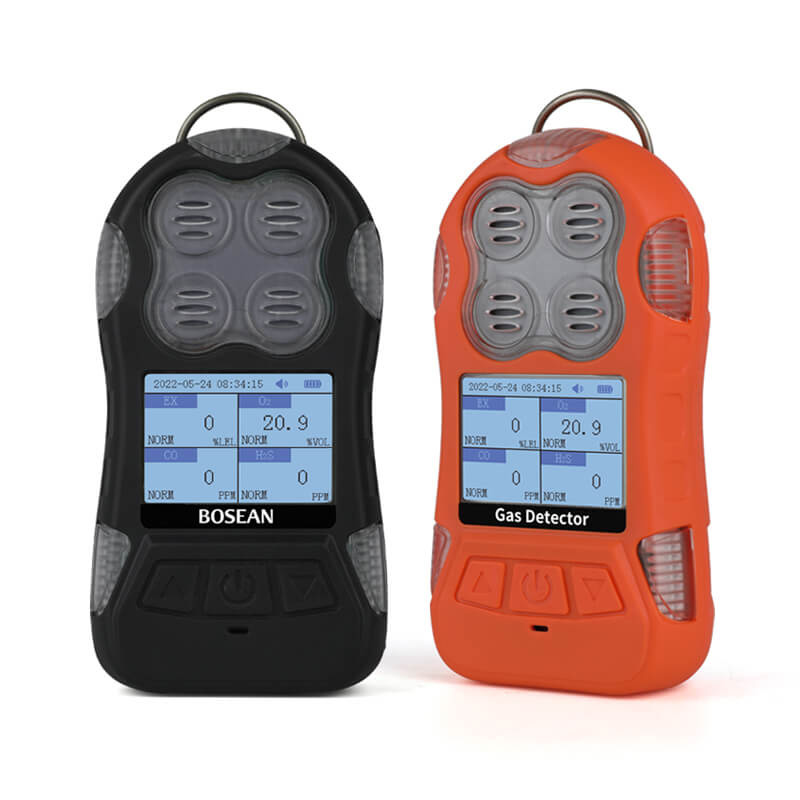
The Bosean K-40 4 in 1 Multi Gas Detector is designed for industrial gas monitoring and workplace safety applications. It incorporates advanced large-scale integrated circuit technology, intelligent design technology, and proprietary digital-analog hybrid communication technology. Using natural diffusion sampling, the detector monitors surrounding atmospheric conditions without requiring a built-in sampling pump.
The K-40 uses high-quality gas sensors as its sensitive elements, offering excellent sensitivity and repeatability. Its design supports convenient operation and maintenance, helping meet the reliability requirements of industrial safety monitoring equipment. As a multi-gas detection instrument, it provides a practical option for organizations that need to monitor atmospheric conditions in different industrial environments.
Durability is another important feature of the K-40. Its housing combines high-strength engineering plastics with composite non-slip rubber, providing a robust structure, comfortable grip, and protection against water, dust, and explosions. These construction features help the instrument adapt to demanding industrial working conditions.
The K-40 is widely used across various industries, including oil and gas, chemical processing, environmental protection, metallurgy, refining, gas transmission and distribution, biomedicine, and agriculture. For organizations selecting a portable multi gas detector, its natural diffusion sampling method, high-quality sensing elements, and durable housing make it a practical choice for general industrial gas monitoring.
How to Choose the Right 4 Gas Detector for Industrial Operations
Comparing manufacturers is only one part of the purchasing process. Industrial buyers should first identify the gases present in their working environments and determine whether standard four-gas monitoring is sufficient.
The following factors deserve attention:
Sensor configuration: Check whether the instrument detects the specific combustible and toxic gases relevant to the workplace. A standard configuration may not cover every potential hazard.
Sampling method: Diffusion monitoring suits personal atmospheric monitoring, while pumped sampling is useful for checking remote spaces before entry.
Alarm performance: Audible, visual, and vibration alerts help workers recognize hazardous conditions in noisy or visually demanding environments.
Environmental protection: Consider ingress protection, operating temperature, humidity tolerance, and housing durability.
Battery performance: Operating time should match the expected work shift, including preparation and inspection activities.
Maintenance requirements: Calibration, bump testing, sensor replacement, and maintenance support should be included in the total cost of ownership.
A multi gas detector for confined space entry should also be evaluated against applicable workplace regulations and site-specific safety procedures. Buyers should verify the instrument’s certifications, sensor specifications, and suitability for the intended hazardous area before purchasing.
A 4 gas detector is not a replacement for a complete confined-space safety program. Atmospheric testing, ventilation, entry permits, emergency arrangements, and continuous monitoring remain essential where required.
Making a Better Investment in Industrial Gas Detection
Industrial Scientific, RKI Instruments, and Bosean offer different approaches to portable gas monitoring. Industrial Scientific provides options ranging from flexible personal monitoring to connected safety systems. RKI Instruments focuses on compact monitoring equipment with practical alarm and sampling features. Bosean offers configurable detection instruments for organizations with varied industrial requirements.
The best purchasing decision depends on the gases involved, working conditions, monitoring procedures, and maintenance expectations. Bosean‘s K-40 is worth considering when buyers need a configurable instrument with multiple alarm methods and a durable portable design.
For industrial distributors, safety equipment suppliers, and end users, comparing technical specifications rather than relying solely on brand recognition can lead to a more suitable investment. Selecting the right instrument helps strengthen workplace monitoring practices and supports safer industrial operations.