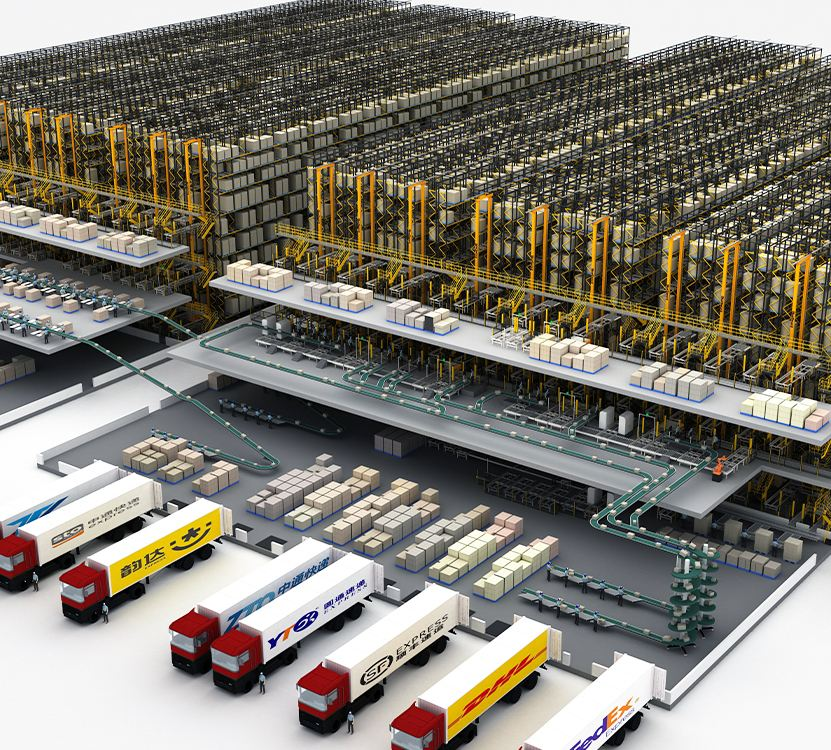
Fast-moving consumer goods move through supply chains under constant pressure: demand changes quickly, sales channels are increasingly diversified, and customers expect products to arrive on time and in the right quantities.
For FMCG logistics companies, improving delivery speed and accuracy starts inside the warehouse, where storage, retrieval, picking, and internal transport directly affect fulfillment performance. BlueSword’s FMCG warehouse automation solutions integrate intelligent logistics systems, automation equipment, and robotics technologies to help improve operational efficiency and support more consistent warehouse processes.
Build Faster Storage and Retrieval
A practical first step is to reduce unnecessary movement between storage and order fulfillment. The FMCG solution combines pallet-level and case-level approaches to support high inventory capacity and significant throughput. For instance, the BlueSword MiniLoad-Zephyr stacker crane uses advanced S-curve control technology to operate stably at speeds of up to 240 m/min (with horizontal speeds varying across models and applications), supporting fast order picking. For consumer goods logistics operations, this performance shortens the path from inventory to the next fulfillment stage while significantly reducing labor dependency.
Case handling also adapts to the wide variety of FMCG packaging. The variable shuttle solution is compatible with various carton and turnover-box sizes, while its intelligent-storage approach incorporates variable-size technology with adaptive fork adjustment. This flexibility enables consumer goods logistics operations to handle mixed packaging requirements without forcing items into a single, fixed format.
Furthermore, flexible variable-size shuttle robots enhance high-density storage efficiency by dynamically transporting diverse bins and cartons, featuring adjustable mechanisms to handle multiple box sizes for advanced storage tasks.
Independently, taking the BlueSword Gecko (Sky-MiniLoad) Case-Handling Robot as an example, these systems feature adjustable load-platforms and multi-directional capabilities to execute advanced picking tasks (such as double-deep and double-position operations). Their seamless integration with conveyors, AGVs, and workstations builds a cohesive link from high-level storage to ground-level zones.
Improve Accuracy Through Controlled Handling
Speed creates value only when the right goods reach the right destination. The FMCG solution integrates smart storage and sorting with fully automated handling, helping improve order execution and handling consistency, while goods-to-person and pick-to-light systems boost picking efficiency. These capabilities address a central requirement for FMCG logistics: reducing manual handling steps while making order execution more consistent.
The Gecko Case-Handling Robot incorporates safety and positioning mechanisms that ensure accurate movement. Laser obstacle-avoidance radar protects vehicle operation, photoelectric detection secures goods during loading and unloading, and servo motors combined with absolute positioning deliver precise placement. Furthermore, its rail-based structure maintains stable operation, while polyurethane-coated wheels and independent suspension minimize vibration and noise.
Match Pallet Movement With Flexible Automation
Not every FMCG flow is carton-level. Where pallet handling is required, a heavy-load, high-lift automated logistics vehicle is utilized for transport and rack-handling scenarios. Its composite navigation uses laser SLAM, with online map updates for changing environments. The vehicle also includes 360-degree laser obstacle avoidance, 3D visual obstacle avoidance, fork collision detection, and pallet-in-position and departure detection.
This flexibility is relevant to consumer goods logistics because warehouse layouts and pallet tasks can differ substantially. The manual describes applications including warehouse connection, dense floor storage, and high-bay racks, with variants for ground transfer, narrow aisles, high racks, conveyors, and different pallet types. The robot can also be deployed with minimal civil construction changes, supporting a fast-deployment approach for technical upgrades. They can therefore fit automation into existing operating environments without making warehouse redesign the only path to improvement.
Connect Automation With Intelligent Control
Equipment alone does not create a fast fulfillment operation. BlueSword’s FMCG solution page emphasizes advanced algorithms and intelligent software to improve overall system efficiency and optimize logistics management. It also presents digital twins for real-time 3D monitoring, proactive maintenance, and improved system stability. For FMCG logistics companies, connecting storage, handling, and software logic is therefore important: the objective is not simply to move products faster, but to coordinate inventory and material flow more effectively.
A balanced automation strategy should also consider deployment flexibility and operating continuity. The Gecko Case-Handling Robot uses modular installation and a one-vehicle, one-rail configuration, allowing rapid deployment and flexible expansion. Additionally, the equipment can be easily relocated between warehouses for reuse. Its sliding-contact power supply enables continuous 24-hour operation without charging or battery replacement. These characteristics can support consumer goods logistics environments where demand patterns and warehouse requirements change over time, while helping operators avoid tying every future capacity adjustment to a completely new installation.
Conclusion
Improving FMCG delivery speed and accuracy requires more than accelerating a single warehouse task. An effective approach combines high-speed retrieval, adaptable case handling, precise positioning, pallet automation, and intelligent system control. This strategy preserves flexibility to adapt when product mixes, order profiles, or warehouse layouts change, rather than optimizing one isolated process.
By coordinating case-level and pallet-level handling, BlueSword can configure an automation strategy around a warehouse’s product mix, order profile, and delivery requirements.