Commercial and industrial microgrids are becoming more sophisticated as businesses combine battery storage, renewable generation, critical loads, and grid-interactive operation. A commercial PCS must therefore do more than convert energy between AC and DC. For system integrators, EPC contractors, and facility owners, selection should consider grid-forming capability, load behavior, parallel operation, communications, environmental conditions, and compliance documentation.
Why Grid-Forming Capability Matters in C&I Microgrids
A conventional grid-following inverter generally depends on an existing voltage and frequency reference. Grid-forming technology takes a different approach by helping establish voltage and frequency, making it relevant to islanded microgrids and applications requiring controlled transitions between grid-connected and off-grid operation.
NREL research highlights functions such as voltage and frequency ride-through, reactive power support, adjustable protection settings, and communications as important considerations when specifying inverter systems for microgrids.
For commercial facilities, this capability can support applications where critical loads must remain energized when utility service is interrupted.
Evaluate the PCS Module Around Actual Load Behavior
Load characteristics should be examined before selecting a PCS module. Commercial facilities rarely have perfectly balanced three-phase loads. HVAC systems, motors, lighting, servers, chargers, and other equipment can create different phase loading patterns.
Enjoypowers’ 105/125 kW bidirectional PCS is designed with independent three-phase control and specifies support for 100% unbalanced loads at full rated power. Its published specifications list rated AC power of 105 kW or 125 kW, depending on model, with a 400 Vac, 3P+N+PE output.
This type of capability can be particularly relevant where a microgrid must support uneven commercial or industrial loads without unnecessarily derating available power.
Check DC and AC Electrical Compatibility
Voltage compatibility is another fundamental selection criterion. The Enjoypowers 105/125 kW PCS is identified as a 1000 Vdc-class grid-forming PCS, with a published DC operating range of 615–950 Vdc for the listed configurations. Its maximum DC current is specified as 175 A.
On the AC side, the unit operates at 400 Vac and supports both 50 Hz and 60 Hz operation. Engineers should match these parameters with the battery system, switchgear, transformer arrangement, and facility distribution network rather than evaluating the PCS independently.
The objective is to ensure that the PCS operating window aligns with the complete electrical architecture.
Consider Black Start and Grid Transition Requirements
Microgrid projects often require more than backup energy. They may need the storage system to establish a local electrical reference, transition between grid-connected and islanded modes, and restore selected loads in a controlled sequence.
Enjoypowers states that its PCS supports grid-forming VSG/VF control and black start. The company also specifies seamless on/off-grid transfer of less than 20 ms when the PCS is combined with its STS architecture.
These functions should be evaluated against the facility’s actual transfer strategy, protection coordination, critical-load requirements, and generator integration plans.
Look at Parallel Operation Before Scaling the System
Capacity requirements can change over the operating life of a C&I project. A modular architecture allows system designers to build capacity from multiple PCS units instead of relying on one large conversion block.
The Enjoypowers 105/125 kW platform supports up to 12 units operating in parallel without communication wiring under VSG grid-forming control, according to its published product information. The company describes configurations ranging from individual cabinets to megawatt-scale containerized systems using the same module platform.
For business project teams, this can simplify capacity planning, but the final architecture should still account for protection, fault-current behavior, thermal management, SOC balancing, and system-level controls.
Examine Grid Stability and Power Quality Features
A grid-forming PCS may operate in environments where voltage and frequency are not ideal. Microgrid designers should therefore review the inverter’s behavior during disturbances rather than focusing only on nominal efficiency or power ratings.
Enjoypowers specifies virtual impedance and adaptive damping for its 105/125 kW PCS and states that the unit can tolerate grid voltage distortion up to 30% THDu. The published specifications also state output THDi below 3% and voltage-sag ride-through down to 0.1 p.u.
These are manufacturer-published specifications and should be validated against project-specific grid studies and applicable interconnection requirements.
Verify Communications and CEC Documentation
Communications are another practical consideration for commercial microgrids. The Enjoypowers PCS supports Modbus TCP/RTU and CAN 2.0B, allowing integration with higher-level energy-management systems and other project controls.
For projects targeting Australia, compliance documentation deserves particular attention. The Clean Energy Council maintains an approved inverter and Power Conversion Equipment program, with requirements covering applicable standards and supporting documentation.
The CEC also states that AS/NZS 4777.2:2020 Amd 2:2024 took effect for relevant inverter applications from August 23, 2025. Project teams should therefore verify the current approval status and applicable documentation for the exact model being specified.
Assess Environmental and Maintenance Requirements
A C&I PCS may be installed in factories, outdoor energy-storage areas, or other environments that expose electronics to dust, humidity, salt, or temperature variations. Enclosure design and cooling therefore deserve the same attention as electrical specifications.
Enjoypowers states that its 105/125 kW PCS uses conformal potting, an IP66 enclosure, C5 anti-corrosion coating, and operation at 50°C ambient temperature without derating. However, the published technical specification table identifies the standalone PCS module’s ingress protection as IP20, so buyers should distinguish between the module-level specification and the protection provided by the completed cabinet or system enclosure. That distinction is important during procurement and site design.
Build the Selection Around the Complete Microgrid
Selecting a grid-forming commercial PCS should ultimately be a system-engineering exercise. Project teams need to assess battery voltage, AC distribution, load imbalance, islanding strategy, transfer time, parallel capacity, communications, environmental conditions, protection coordination, and regional compliance together.
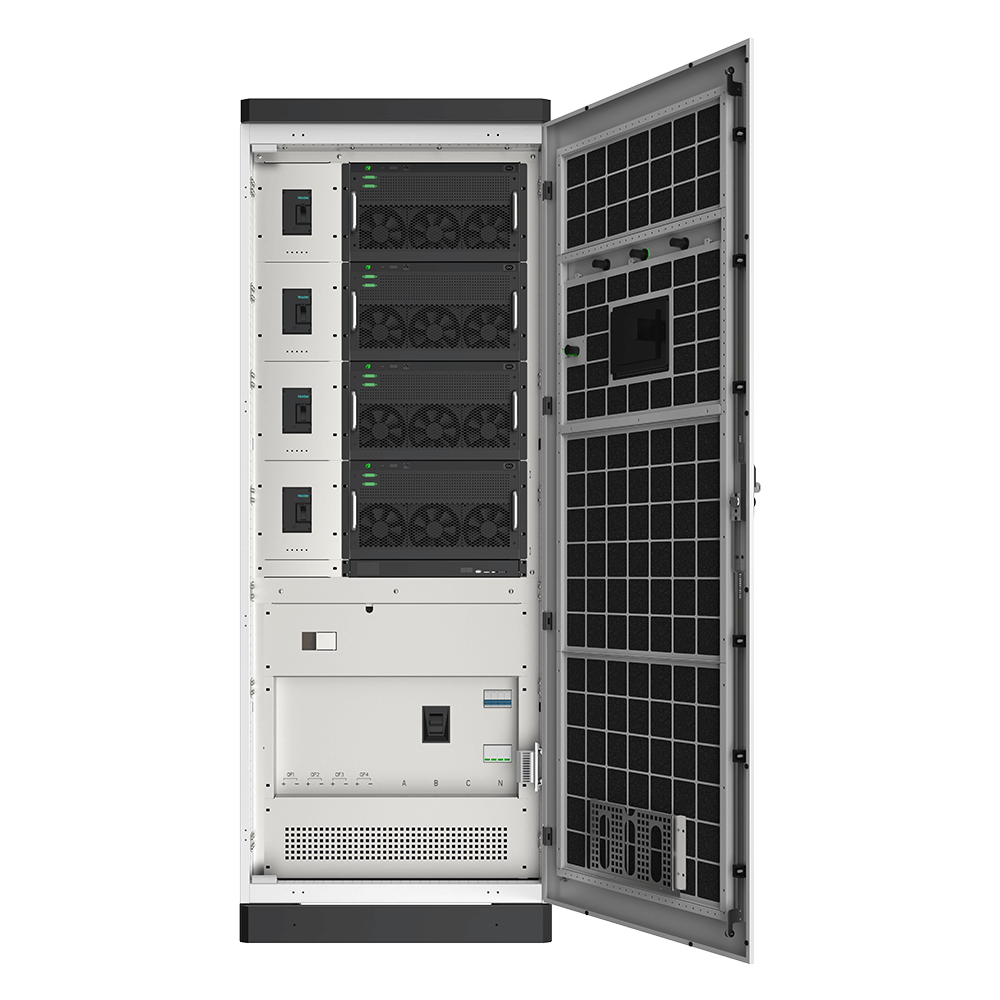
Enjoypowers‘ 105/125 kW bidirectional PCS module provides one example of a modular C&I approach, combining VSG/VF grid-forming control, 100% unbalanced-load capability, up to 12-unit communication-less parallel operation, and documentation provided for Australian CEC requirements.
For EPC contractors, integrators, and commercial energy users, the most useful PCS specification is ultimately the one that fits the entire microgrid architecture. A careful evaluation at the design stage can make integration, commissioning, expansion, and long-term operation more predictable.