In peripheral vascular intervention, crossability describes how effectively a device advances across target lesions. For procurement teams and distributors, this term must extend beyond marketing claims. A rigorous technical evaluation considers crossability alongside engineering characteristics such as distal tip profile, shaft flexibility, outer diameter, trackability, pushability, and guidewire compatibility.
When evaluating peripheral vascular devices, buyers should therefore look beyond general marketing language. Manufacturers should explain which design elements contribute to navigation and provide specifications that allow customers to make meaningful product comparisons.
What Does Crossability Mean in Peripheral Intervention?
Crossability generally refers to a device’s ability to advance through the vascular pathway and negotiate a target lesion without excessive resistance. In peripheral procedures, this characteristic can become particularly relevant when devices must navigate vessels with bends, narrowing, or other anatomical challenges.
However, crossability is not determined by a single specification. It is influenced by the relationship between several design elements. A flexible distal section may help the device follow vessel geometry, while an appropriate shaft structure can contribute to pushability and torque response. A smaller distal profile may also affect the ability to reach certain anatomical locations.
For medical-device purchasers, manufacturers should describe these characteristics separately instead of treating “crossability” as an all-purpose performance claim.
Which Design Features Influence Crossability?
Distal Flexibility and Tip Design:
The distal portion of a catheter plays an important role in navigation. A flexible tip can help the device follow curved vascular paths, while a tapered or appropriately shaped distal profile may facilitate advancement.
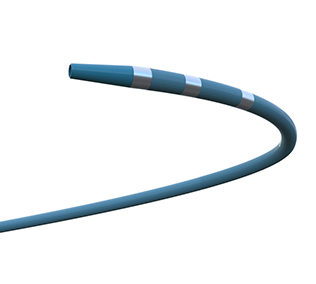
Radiopaque markers are another relevant design feature because they allow the position of the distal portion to be visualized under fluoroscopy.
Catheter Profile and Internal Lumen Specifications
Dimensional specifications should also be considered when comparing peripheral intervention devices. A smaller outer diameter can be relevant to access and navigation requirements, while the inner diameter affects what the catheter can accommodate or deliver.
Shunmei’s published specifications for its Shun Thros peripheral microcatheter identify a 2.6F/2.9F distal/proximal outer diameter configuration and a 0.48 mm (0.019″) distal inner diameter. The documentation also lists effective lengths of 105 cm, 125 cm, and 150 cm for specified configurations.
it’s peripheral microcatheter documentation, for example, specifies a 3 mm soft tip and three platinum-iridium alloy radiopaque marker bands, with 10 mm spacing between the marker bands. These are concrete design details that provide buyers with more useful information than a general statement about “good crossability.”
Taken together, these specifications allow procurement teams to compare products according to actual dimensions, distal-end design, and radiographic visibility rather than relying on broad performance descriptions.
Why Shaft Construction Matters for Device Navigation
Crossability should also be considered together with pushability and support. A catheter that advances through a vessel needs an appropriate balance between distal flexibility and proximal support.
For example, Shunmei’s published Shun Thros documentation describes a three-layer catheter structure and identifies the PTFE inner cavity as supporting smooth transportation. The same documentation describes the variable-diameter structure, with the outer diameter gradually decreasing toward the distal end. Its listed configurations include a nominal pressure of 800 psi.
For buyers, these specifications help explain how a manufacturer approaches catheter construction. They also provide useful points for supplier-to-supplier comparison when technical teams are reviewing product portfolios.
How Should Buyers Compare Peripheral Intervention Devices?
When evaluating peripheral intervention devices, procurement teams must request comprehensive technical specification sheets rather than relying solely on promotional terms like crossability. A rigorous comparison systematically analyzes distal and proximal outer diameters, inner diameter dimensions, effective catheter length, distal tip design, and specific soft-tip length measurements across candidate device lines.
In addition, technical audits should verify radiopaque marker configurations, guidewire compatibility, shaft construction, pressure ratings, and hydrophilic coating coverage. This structured narrative approach enables distributors to compare products across international markets accurately while facilitating clearer technical communication with hospital purchasing departments.
Describe Crossability With Evidence, Not Superlatives
Manufacturers should avoid unsupported expressions such as “effortless crossing” or “superior navigation.” Such descriptions do not tell professional buyers what actually differentiates the product.
A stronger technical description identifies the specific design characteristics supporting navigation. For example, manufacturers can explain the relationship between distal flexibility, shaft structure, outer diameter, marker visibility, and guidewire compatibility. This gives procurement teams a clearer basis for evaluating whether a product fits their intended application.
Shunmei’s peripheral intervention portfolio includes peripheral IVL catheters, cutting balloons, balloon dilatation catheters, drug-coated balloon dilatation catheters, guidewires, and microcatheters. This broader portfolio can also be considered when buyers are assessing whether a supplier’s product range aligns with their peripheral intervention sourcing needs.
Choosing a More Transparent Device Supplier
For medical-device distributors and procurement teams, clear technical documentation is an important part of supplier evaluation. Crossability should be presented as a combination of design characteristics and specifications rather than as an isolated promotional claim.
When reviewing products from Shunmei, buyers can examine the published peripheral intervention portfolio and product documentation, then contact the manufacturer for current specifications, configurations, and market-specific regulatory information. This provides a more practical starting point for comparing device design and selecting products according to actual procedural and procurement requirements.