Understanding the core mechanics behind synthetic textile decoration is crucial before transitioning to digital thermal transfer technology. Industrial textile processing demands a clear view of what is sublimation printing in terms of heat activation, molecular bonding, and dye dispersion across synthetic fibers.
Evaluating capital investments requires production managers to analyze equipment speed, ink efficiency, and substrate handling capacity. Integrating specialized equipment into existing textile workflows allows manufacturers to expand output while managing operational overhead.
Fundamental Chemistry and Thermal Physics
Dye-sublimation physics relies on solid disperse dyes turning directly into gas without liquifying under high temperatures. Heated polyester polymers expand their molecular lattice, allowing vaporized dye particles to penetrate deep into individual fibers.
Once the thermal press cycle finishes, cooling locks color molecules permanently within the synthetic matrix. Fabrics treated through this method retain their original surface texture and structural flexibility without cracking or peeling over time.
Core Components of Production Hardware
Mechanical precision drives reliable dye deposition across broad textile rolls during continuous operation. A high-speed Sublimation Printer employs multi-head printhead configurations to deposit micro-droplets with uniform density across high-volume production cycles.
Heavy-duty frame construction prevents operational vibration that causes horizontal banding across rapid carriage movements. Smooth drive systems keep carriage motion stable, protecting image definition on detailed graphics.
Media Selection and Fabric Compatibilities
Polyester blends and pure synthetic fibers serve as the primary substrates for digital heat transfer processing. Natural fibers like cotton or wool lack the chemical structure needed to capture disperse dye gases during thermal activation. Understanding this inherent material constraint guides production planners in matching job specifications to appropriate fabric stocks, avoiding costly trial-and-error on incompatible substrates.
Selecting appropriate transfer paper weights prevents paper cockling and ink bleed during high-density passes. Lightweight papers speed up heat transfer cycles, while heavy coated papers hold intricate details for complex graphic designs. Proper paper selection not only maximizes ink transfer efficiency but also minimizes heat-press dwell times, directly impacting throughput rates and energy consumption per finished unit.
Dual-Sided Processing for Flag Manufacturing
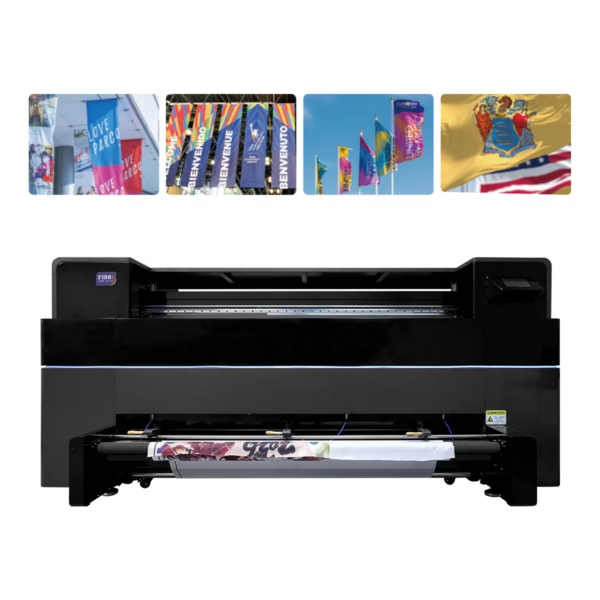
Visual display manufacturing often requires vivid ink penetration on both front and back fabric surfaces. Solutions designed by Xinflying incorporate dual-printhead configurations that align two-sided printing across porous flag fabrics.
Engineered models like the XF-2180A utilize an array of eight i1600 printheads to execute rapid double-sided graphics without registration errors. Direct fabric penetration yields vibrant banners visible from both directions under outdoor lighting conditions.
Integrated Post-Processing and Fixing Systems
Combining multiple production stages into a unified workflow reduces manual labor in high-volume facilities. Operating a specialized Sublimation Printer equipped with inline heat setting units streamlines flag and banner assembly.
Streamlined processing shortens order turnarounds while lowering material damage caused by repeated fabric handling. Integrated heating zones cure dyes instantly, preparing finished banners for immediate packaging.
Ink Management and Flow Dynamics
Continuous fluid transport keeps piezoelectric nozzles primed throughout long operational shifts. Equipment supplied by Xinflying features bulk ink delivery channels that stabilize pressure during high-speed printing runs. Automated pressure regulation eliminates manual adjustments between jobs, enabling seamless transitions across varying print speeds and coverage densities without operator intervention.
Inline degassing filters remove micro-bubbles from water-based dye solutions before reaching the printhead nozzles. Preventing air pockets reduces misfires, maintaining sharp line clarity across continuous textile webs. Eliminating entrained air and submicron particulates before they reach the delicate nozzle plate critically reduces the incidence of random dropouts, banding, and comet-tail artifacts that otherwise degrade image quality.
Digital Workflow and File Preparation
Digital raster image processing controls color channel mapping, ink limits, and layout nesting before jobs hit the factory floor. Print managers adjusting what is sublimation printing parameters rely on RIP software to simulate color rendering accurately across varying fabric bases.
Vector file preparation enables quick design adjustments without incurring physical screen preparation fees. Electronic color management allows short-run customization alongside large-scale contract orders.
Operational Footprint and Environmental Impact
Water-based disperse inks release minimal volatile organic compounds during heat activation, supporting cleaner factory environments. Operating an industrial sublimation printer reduces chemical washing requirements compared to traditional wet dyeing methods. By virtually eliminating hazardous air pollutants from the dyeing stage, manufacturers can more readily attain eco-certifications and satisfy stringent emission caps without retrofitting exhaust treatment systems.
Lowering water consumption helps textile facilities meet regional environmental standards while cutting utility costs. Reduced waste material generation supports cleaner, more efficient industrial production lines. Minimized effluent and solid waste outputs empower textile producers to market themselves as environmentally responsible supply-chain partners, meeting growing brand demand for lower-impact decoration methods.
Maintenance Schedules and Hardware Longevity
Preventative maintenance modules extend nozzle plate life by automatically removing dried ink build-up. Mechanical components from Xinflying, such as precision linear guides and heavy-duty drive belts, preserve long-term carriage stability.
Implementing the XF-2180A in high-output environments allows operators to run extended shifts with minimal manual intervention. Scheduled cleaning cycles prevent clogging and safeguard print quality during heavy workload periods.
Conclusion
Transitioning to digital dye transfer equipment offers textile facilities enhanced flexibility, rapid turnarounds, and durable color output across synthetic fabrics. Exploring what is sublimation printing hardware configurations helps commercial print providers optimize daily operations and build long-term manufacturing resilience.