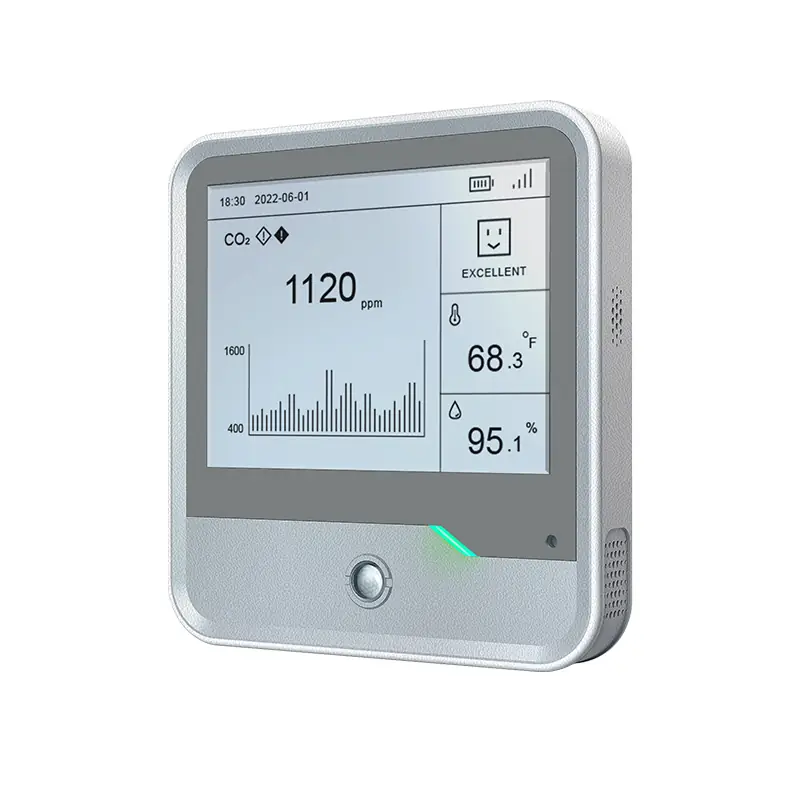
Selecting an indoor environmental monitoring device requires more than comparing product prices or measurement functions. Commercial and industrial projects often involve multiple monitoring locations, centralized management, and long-term operation, making the selection process different from purchasing a household detector. HKT LORA recommend evaluating monitoring requirements, communication methods, deployment flexibility, and system compatibility before choosing a solution. Their LoRaWAN Indoor Air Quality Sensor is designed for professional indoor monitoring applications where wireless networking and centralized management are important considerations.
Understanding Project Requirements Before Choosing an Air Quality Sensor
Every purchasing decision should begin with the intended application rather than the product specification sheet. Household detectors are generally installed in a single room and provide local environmental readings for individual users. Industrial and commercial projects, however, usually require monitoring information from multiple indoor locations that can be managed through one communication system.
Before selecting a device, purchasers should determine the number of monitoring points, the building layout, and whether environmental information needs to be collected from several areas simultaneously. These factors help identify whether a standalone detector or a LoRaWAN-based monitoring solution is more appropriate for the project.
Comparing Monitoring Functions of an air quality sensor
Monitoring capability is one of the first aspects buyers evaluate. A household detector is commonly selected to observe one or several environmental indicators within a limited indoor space. Commercial facilities, educational buildings, and healthcare environments often require a broader understanding of indoor conditions across different locations.
LoRaWAN Indoor Air Quality Sensor integrates multiple environmental monitoring functions into one device. According to the selected configuration, it supports temperature, humidity, carbon dioxide, PM2.5, PM10, TVOC, atmospheric pressure, light intensity, and optional sensing functions such as formaldehyde, ozone, and motion detection. Integrating these monitoring capabilities into a single device helps simplify deployment while supporting more comprehensive indoor environmental observation.
Evaluating Communication Methods of an air quality sensor
Communication technology directly affects how monitoring information is collected and managed. Household detectors generally display information locally and are intended for independent operation within a single room. Their communication capabilities may not be designed for large-scale distributed monitoring.
Their solution adopts the standard LoRaWAN protocol, allowing monitoring data to be transmitted to compatible LoRaWAN gateways before being forwarded to a network server or cloud platform. This communication architecture enables multiple sensing devices to operate within one wireless monitoring system, making it suitable for projects that require centralized management across numerous indoor locations.
Considering Installation Flexibility of an air quality sensor
Installation requirements often differ between residential and professional environments. Home users usually install one detector in a convenient location, while commercial projects may involve dozens of devices distributed throughout offices, classrooms, meeting rooms, waiting areas, or public spaces.
Their device supports adhesive mounting as well as screw installation, allowing deployment according to interior construction conditions. Battery operation provides additional flexibility when planning installation locations, helping project teams adapt deployment to different building layouts without relying on a single installation method.
Reviewing Information Management Through an air quality sensor
Displaying environmental information is only one part of an indoor monitoring solution. For professional users, monitoring information is often reviewed by maintenance personnel, facility managers, or system administrators who require access to multiple monitoring points rather than a single device.
The integrated E-Ink display allows environmental information to be viewed directly at the installation location during routine inspections. At the same time, compatible cloud platforms provide centralized access to information transmitted through the LoRaWAN network, allowing distributed devices to be managed within one monitoring environment.
Assessing Scalability of an air quality sensor
A monitoring project rarely remains unchanged throughout its lifecycle. New offices, classrooms, consultation rooms, or operational areas may require additional monitoring devices after the initial deployment has been completed. Buyers should therefore consider whether the selected solution can accommodate future expansion without replacing the existing communication infrastructure.
Because their Indoor Air Quality Sensor follows the standard LoRaWAN protocol, additional compatible devices can be incorporated into the same wireless network as monitoring requirements increase. Existing gateways and management platforms continue supporting both original and newly installed devices, helping organizations expand their monitoring coverage gradually.
Choosing a Supplier for an air quality sensor
Selecting a monitoring device also involves evaluating the capabilities of the supplier. Beyond hardware, buyers should consider whether the manufacturer provides products that can operate within a complete LoRaWAN ecosystem. Compatibility with gateways, support for cloud platforms, and standardized communication are all practical factors that influence long-term deployment.
It is also helpful to review installation methods, available sensing configurations, and product integration options before making a purchasing decision. Choosing a supplier that focuses on LoRaWAN technology can simplify future expansion and reduce integration challenges when additional monitoring devices are introduced.
Selecting HKT LORA for Professional Indoor Monitoring
Purchasing an indoor monitoring solution should focus on practical deployment requirements instead of comparing individual product specifications alone. Communication compatibility, multi-parameter monitoring, flexible installation, and centralized management all contribute to a monitoring system that can adapt to changing project requirements over time.
At HKT LORA, they develop professional LoRaWAN IoT products designed for commercial and institutional applications. Their product portfolio includes LoRaWAN Indoor Air Quality Sensors, compatible gateways, and supporting cloud management solutions that help customers establish reliable indoor monitoring systems based on standard technology. By combining practical product design with standardized wireless communication, HKT LORA supports customers seeking scalable and efficient environmental monitoring solutions for a wide range of professional indoor environments.