Municipal roads and public spaces require regular cleaning to maintain a safe and comfortable environment for residents and visitors. Choosing the right cleaning equipment depends on factors such as road conditions, cleaning frequency, dust control needs, and operating efficiency. For city management departments and facility operators, a suitable street sweeper should not only remove dust and debris but also adapt to different outdoor environments. When evaluating equipment options, many buyers compare cleaning performance, operation methods, maintenance requirements, and long-term usage costs.
Key Factors to Consider When Selecting a Street Sweeper for Urban Cleaning
A practical street sweeper should match the requirements of the areas being cleaned. Municipal roads often include different surfaces, traffic conditions, and levels of dust accumulation. Equipment used in these environments needs stable cleaning performance and flexible operation. Public spaces such as parks, plazas, and transit areas may require quieter operation and better maneuverability because they are frequently used by pedestrians.
Cleaning capacity is another important consideration. Buyers should review parameters such as cleaning width, working speed, waste container capacity, and operating time. These specifications directly influence how much area can be cleaned during each shift. For example, a machine with a wider cleaning path can reduce repeated passes when handling large outdoor areas.
The cleaning method also affects daily results. Traditional sweeping equipment may focus mainly on collecting visible debris, while modern solutions combine suction, water spraying, and dust control functions. This allows operators to manage different types of cleaning tasks with fewer equipment changes.
Why Street Sweeper Manufacturers Focus on Intelligent Cleaning Solutions
Modern street sweeper manufacturers are developing equipment that combines mechanical cleaning systems with intelligent technologies. Urban cleaning environments are becoming more complex, requiring machines that can work efficiently around obstacles, narrow pathways, and mixed-use areas.
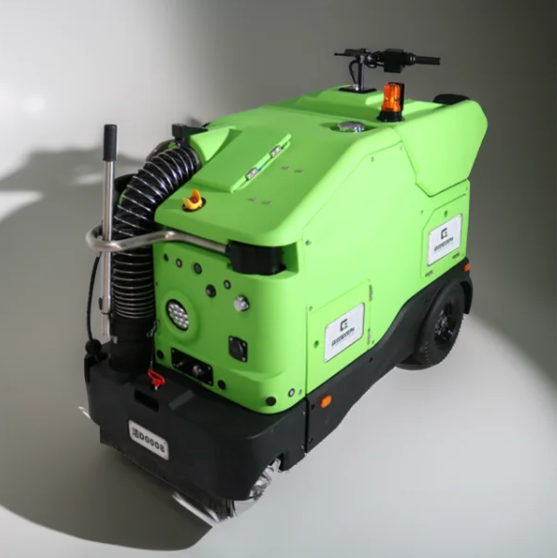
Greendorph focuses on commercial cleaning robot solutions designed for public and industrial environments. They develop cleaning equipment that integrates functions such as suction collection, dust suppression, and intelligent control. Their YJ80 Vacuum Street Sweeper is designed for streets, parks, transit hubs, and urban plazas where consistent cleaning performance is required.
The YJ80 uses a high-performance negative-pressure suction system to collect dust and debris effectively. The system works together with multiple cleaning functions, including vacuum-tube collection, intelligent dust-suppression misting, airflow blowing, water spraying, and high-pressure surface flushing. This design combines several traditional cleaning methods into one electric cleaning machine.
How YJ80 Improves Cleaning Efficiency in Public Spaces
The Greendorph YJ80 is designed as a fully electric cleaning solution for urban environments. Compared with equipment that relies on traditional power systems, the electric design supports quieter operation and reduces direct emissions during cleaning tasks. It can operate for around 6–8 hours depending on working conditions, making it suitable for daily cleaning schedules.
The machine provides a cleaning width of 140cm and a cleaning efficiency of up to 10,800m²/h. These features allow operators to cover larger areas within a working period. The 100L waste bin with an additional 12L capacity and 120L water tank support longer cleaning cycles before maintenance stops are needed.
For locations with different cleaning requirements, the YJ80 provides dry and wet cleaning functions. Dry functions include sweeping, vacuuming, and blowing. Wet functions include water spraying and high-pressure water washing. The high-pressure washing system operates at around 15MPa, helping remove more difficult surface contaminants in suitable applications.
Choosing Between Manual, Follow, and Automated Cleaning Modes
When selecting a street sweeper, operation flexibility is an important factor for municipal and facility managers. Different locations may require different working methods. Some areas need direct operator control, while others benefit from assisted cleaning functions.
The YJ80 supports three operation modes, including manual ride-on operation, auto-following mode, and towed traction. The auto-following function uses UWB positioning technology, allowing the machine to follow an operator within a range of 1–6 meters and within a ±60° angle. This design supports human-machine cooperation in areas where flexible movement is needed.
The sensor-fusion system also improves working safety in complex environments. The machine integrates multiple sensors, including laser radar, 3D cameras, and ultrasonic sensors, to support obstacle detection. This helps the equipment move more smoothly in areas such as pedestrian plazas, sidewalks, and parking spaces.
Evaluating Reliable Street Sweeper Manufacturers for Long-Term Use
Selecting suitable street sweeper manufacturers requires more than checking product appearance. Buyers should consider technical capability, product reliability, after-sales support, and whether the equipment matches real cleaning conditions.
Greendorph provides commercial cleaning robot solutions with intelligent control and remote management capabilities. Their equipment can support remote platforms, mobile applications, and cloud-based management systems depending on configuration. These functions allow operators to manage cleaning tasks more efficiently and support multiple equipment scheduling.
The YJ80 includes practical specifications for outdoor cleaning applications. It has a compact structure with dimensions of 1820mm in length, 860mm in width, and 1350mm in height. With a climbing ability of 15° and a movement speed of 6 km/h, it can adapt to different outdoor environments. The 48V/300AH lithium battery system supports repeated daily cleaning operations.
Conclusion: Matching Cleaning Equipment with Municipal Requirements
Choosing a suitable street sweeper for municipal roads and public spaces requires careful evaluation of cleaning functions, operating conditions, and management needs. Equipment should provide stable performance while supporting different cleaning tasks in real environments.
The Greendorph YJ80 Vacuum Street Sweeper combines suction cleaning, water washing, dust control, and flexible operation modes in one electric platform. For cities, property managers, and facility operators, selecting equipment based on actual application conditions can help create more efficient and organized cleaning processes.